
Private Office Space in Brighton: What Should a Team of 2–12 Look For?
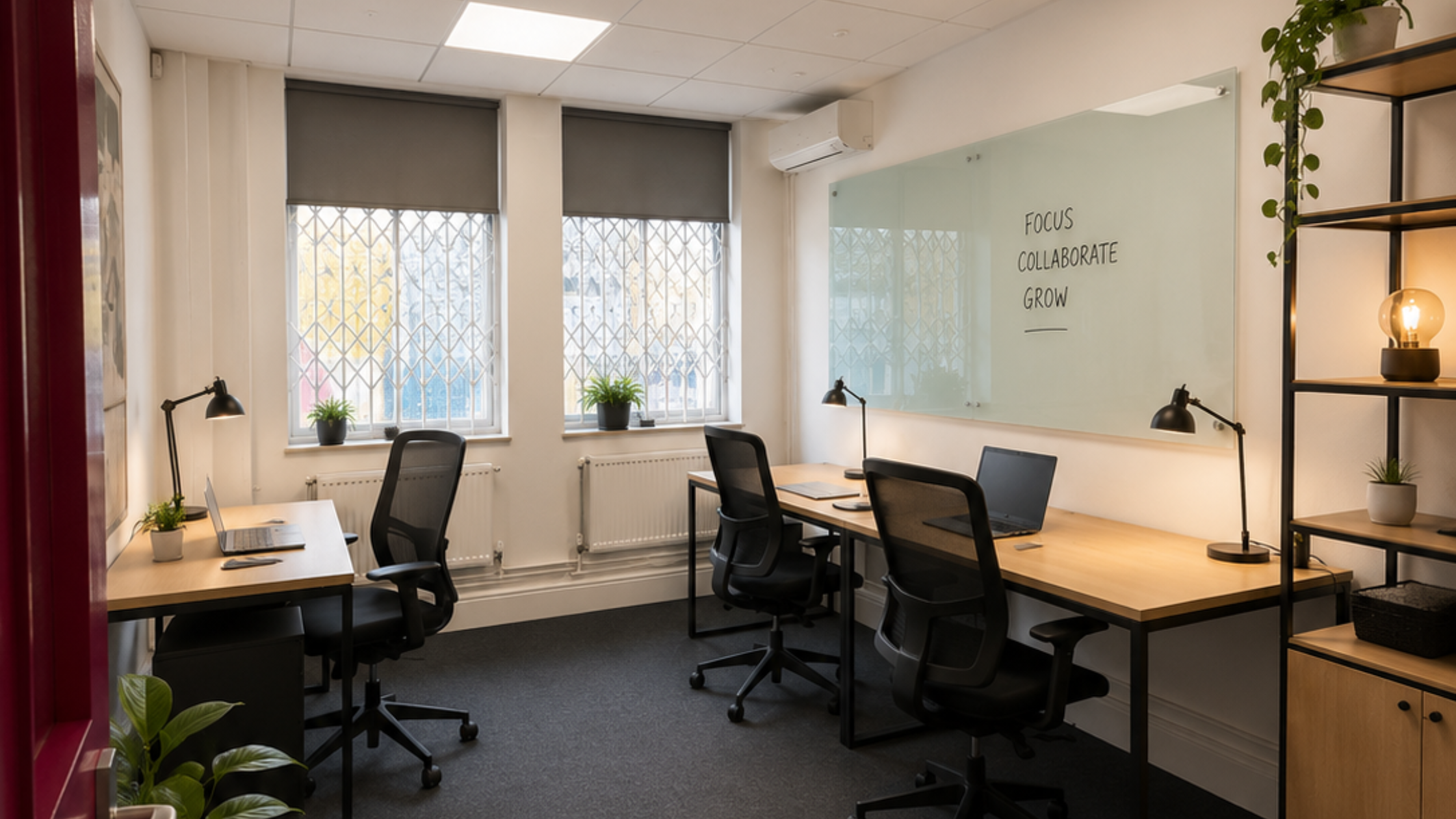
Finding private office space in Brighton isn't particularly difficult.
Finding the right office for a small team is.
For a team of 2–12 people, the decision isn't simply about counting desks and finding a room big enough to fit them. Location, contract flexibility, what's included in the monthly price, meeting space, 24/7 access and your ability to grow can all make the difference between an office that supports your business and one you quickly outgrow.
And Brighton gives businesses plenty of choice.
So before signing for your next office, here's what we think a small or growing team should actually be looking for.
1. Start with how your team works — not how many people you employ
If you have eight employees, do you need an eight-person office?
Maybe.
But not necessarily.
An eight-person team working together five days a week has very different requirements from an eight-person hybrid team where only four or five people are normally in at once.
Before looking at offices, ask:
How many people will regularly work there at the same time?
Does everyone need a permanent desk?
How often does the whole team come together?
Do people spend much of their day on calls?
Do you regularly meet clients?
Do you need somewhere separate for confidential conversations?
Is your team likely to grow during the next 6–12 months?
The goal shouldn't be to squeeze the maximum number of desks into the smallest possible room.
It should be to find enough space for your team to work comfortably and effectively.
2. Think about where in Brighton you actually need to be
“Brighton” covers very different working environments.
For many businesses, a central location is attractive because it gives employees, clients and collaborators easier access to the office. Brighton Station, bus connections, cafés, shops and places to meet outside the office can all become part of everyday working life.
Current Brighton market data also shows occupier demand concentrating particularly around smaller, well-specified offices in central locations.
But central doesn't automatically mean right for everyone.
Think about where your employees travel from, whether clients regularly visit you and how often your team needs access to the station.
A slightly cheaper office isn't necessarily better value if everyone spends considerably longer getting there.
Location is part of your team's working experience, not simply an address on your website.
3. Look beyond the headline monthly rent
This is one of the biggest mistakes businesses can make when comparing offices.
Two spaces can have very different advertised prices while costing almost the same once everything else is included.
Depending on the type of office, additional costs can include:
business rates
electricity and heating
broadband
furniture
cleaning
service charges
maintenance
insurance
meeting-room hire
fit-out
security
deposits and setup costs
With a serviced or flexible private office, several of these may already be included in the monthly price.
That's why we'd always recommend comparing total occupancy cost rather than rent alone.
We've broken this down in more detail in our guide to [how much office space costs in Brighton in 2026].
4. Ask what is actually included
“Serviced office” and “flexible office” don't necessarily mean exactly the same thing from one provider to another.
Before comparing quotes, get a clear list of what's included.
Ask specifically about:
Furniture
Are desks and chairs already provided?
Internet
Is Wi-Fi included? Is it suitable for the amount and type of work your team does?
Utilities
Are electricity, heating and water covered?
Business rates and service charges
Are they included or additional?
Cleaning
Does this include just communal areas or your private office too?
Meeting rooms
Are they included, discounted or charged separately?
Kitchen and breakout facilities
What can your team actually use outside the office?
Access
Can you enter outside normal reception hours?
The more you establish before signing, the fewer surprises there are afterwards.
5. Don't underestimate the importance of meeting space
A private office gives your team privacy.
That doesn't necessarily mean every conversation should happen inside it.
Imagine four people working while another colleague takes a video call two metres away. Then somebody arrives for a client meeting.
Suddenly, your perfectly adequate five-person office feels very small.
For small teams, access to meeting rooms, breakout areas and shared spaces can be especially valuable because you don't have to pay permanently for extra square footage that you only occasionally need.
So when viewing an office, don't just inspect the room you're renting.
Look at the building around it.
Ask yourself:
Where would we interview someone?
Where would we meet a client?
Where could someone take a private call?
Where could the team step away from their desks?
You're choosing an entire working environment, not four walls.
6. Check when you can actually access your office
Your business might operate from nine to five.
It also might not.
If somebody needs to arrive early, work late, pop in at the weekend or prepare for a Monday morning meeting on Sunday evening, restricted building hours can quickly become frustrating.
Check whether your office offers 24/7 access and whether there are different arrangements outside staffed hours.
This is particularly important for businesses working with international clients, flexible schedules or teams that simply don't all work identical hours.
7. Find out how flexible the contract really is
“Flexible” is a popular word in the workspace industry.
Ask what it actually means.
A flexible office agreement may allow a business to avoid the commitment associated with a long traditional commercial lease, but terms still vary considerably between providers.
Check:
minimum contract length
deposit
notice period
renewal arrangements
what happens if you need a bigger office
whether you can reduce your space
any charges for changing office
what happens at the end of the agreement
This matters particularly for growing businesses.
If you're a four-person company today and expect to become eight people next year, the ability to change spaces within the same workspace could be more valuable than taking a much larger office immediately and paying for empty desks.
8. Ask what happens when your team grows
Nobody wants to move office twice in twelve months.
But the solution isn't necessarily renting an office twice as large as you currently need.
Instead, ask the workspace provider:
“What happens if we outgrow this room?”
If there are different office sizes within the same workspace or across the same provider's locations, you may be able to expand without completely rebuilding your working setup somewhere else.
For a growing small business, that's worth considering before signing.
9. Consider how much you can personalise the space
Your office doesn't need to look like somebody else's office.
For some businesses, a furnished room with desks and chairs is exactly what's needed: arrive, open the laptops and start working.
Others want branding, different desk configurations, plants, screens, storage or areas designed around how the team collaborates.
Ask what's possible before assuming that the existing layout is permanent.
At WERKS, for example, most of our private offices come furnished, but teams can also personalise their setup depending on the office and their requirements.
That's particularly useful when the same physical space could work very differently for two businesses of the same size.
10. Look outside the office door
This is something that's difficult to put into a property listing.
What happens when you leave your office?
If you're renting a standalone unit, the answer might simply be a corridor and the street.
A workspace environment can offer something different.
Shared kitchens, coworking areas, cafés, events, meeting rooms and communal spaces can give a small team some of the advantages normally associated with working in a much larger organisation.
And then there are the people.
Being surrounded by freelancers, founders, creatives and other businesses doesn't mean everyone needs to network every time they make a coffee.
It simply means opportunities for conversation and collaboration exist.
For some teams that's enormously valuable.
For others, privacy matters more.
The important thing is understanding which environment suits your business before choosing it.
What should different team sizes consider?
Private office for 2–4 people
For a very small team, avoid paying for unnecessary space simply because you expect to grow eventually.
Look particularly at:
affordability per month
furnished options
shared meeting rooms
communal facilities
flexible agreements
the ability to move into a larger office later
As a useful real-world reference, WERKS currently has private-office configurations suitable for approximately 3–4 people from around £900 + VAT per month, depending on the particular space and setup.
Private office for 5–8 people
At this size, layout becomes increasingly important.
Think about whether everyone needs a permanent workstation and whether your office needs internal collaboration space.
Access to external meeting rooms and breakout areas can prevent you from paying for a significantly larger private room purely to accommodate occasional meetings.
Private office for 9–12 people
Once a team reaches this size, look beyond how many desks physically fit.
Consider circulation space, calls, storage, hybrid attendance and how often everyone is present simultaneously.
As another indicative WERKS example, some of our private offices can accommodate up to approximately 10 people at around £1,600 + VAT per month, depending on layout, office and availability.
These figures are examples rather than universal WERKS rates. Office availability, configuration and pricing should always be confirmed when you enquire.
A private office or coworking — which does your team actually need?
It's worth asking this before committing to a private office at all.
If your team is very small, rarely in together and doesn't need much privacy, coworking or dedicated desks may make more financial sense.
A private office becomes particularly useful when your business needs:
a consistent home for the team
greater privacy
confidential conversations
permanent equipment or storage
stronger separation from shared working areas
somewhere clients can associate with the business
And the two aren't necessarily opposites.
A private office inside a coworking community can give your team its own door while still providing access to shared facilities and the wider working community.
We'll explore this decision in more detail in our Coworking vs Private Office in Brighton guide.
Why smaller Brighton teams have more choice in 2026
The way businesses use offices has changed.
Hybrid working, smaller teams and greater caution around long property commitments have all influenced what companies expect from workspace.
Brighton reflects that shift.
Recent local market analysis found that demand remains particularly focused on smaller, high-quality, centrally located offices, while landlords offering well-specified and flexible workspace are expected to be best positioned to attract businesses.
For a team of 2–12, that means there are options.
But it also makes comparing those options properly more important.
Don't choose an office because it has twelve chairs.
Choose it because the location, costs, flexibility and environment make sense for the twelve — or four, or seven — people who are actually going to use it.
Finding private office space in Brighton with WERKS
WERKS has been providing workspace for Brighton's freelancers, founders, creatives and businesses since 2007.
Our approach to private offices is simple:
Your business gets its own space without having to work in isolation.
Our private offices sit within a wider working community, with access to shared facilities and spaces depending on the location and membership.
Most offices are furnished, and there's scope to personalise spaces around how your team actually works.
And because businesses don't all fit neatly into “four-person”, “six-person” or “ten-person” boxes, we'd rather understand your requirements first.
Tell us:
How many people are in your team?
How often are you in the office?
What does your team need from the space?
And where in Brighton do you need to be?
Then we can show you the offices that actually fit.
Looking for a private office in Brighton?
If September is the month you've decided it's time for a proper home for your business, come and see what's currently available at WERKS.
You don't need to know exactly how many square feet you need.
Start with your team.
We'll take it from there.
Explore WERKS private offices.
Indicative WERKS prices referenced in this article are correct as of September 2026, exclude VAT and are subject to availability, office configuration and current terms.
Private Office Brighton FAQs
How much does a private office in Brighton cost?
The price depends on the office size, location, facilities and what's included. Serviced offices may bundle costs such as utilities, broadband, furniture and business rates into the monthly fee, so compare total occupancy costs rather than headline rent alone.
How big an office does a team of four need?
There isn't one ideal size. A four-person team that spends every day together has different requirements from a hybrid team. Consider desk space, storage, calls, meetings and access to shared facilities rather than simply fitting four desks into a room.
Can a small business rent a private office in Brighton?
Yes. Brighton has private and flexible office options designed for small businesses, including spaces suitable for teams of only a few people.
Should a startup choose coworking or a private office?
Coworking can work particularly well for very small or highly flexible teams. A private office becomes more useful when you need privacy, permanent desks, equipment, confidential conversations or a dedicated home for the company.
Can private offices come furnished?
Yes, many serviced and flexible offices are furnished, although this varies between providers. Most WERKS private offices come furnished, with opportunities to personalise the setup depending on the space and requirements.
Can I rent a private office without signing a long lease?
Flexible workspace providers can offer alternatives to conventional long commercial leases, but minimum terms and notice periods vary. Always check the exact agreement before committing.
