
Coworking vs Private Office in Brighton: Which Is Right for Your Business?
If you're looking for a workspace in Brighton, one of the first decisions you'll face is whether you actually need your own office.
For some businesses, a private office in Brighton gives the team the privacy, consistency and permanent base they need.
For others, coworking in Brighton offers something more valuable: flexibility, lower commitment and access to a professional workspace without paying for a room that might sit half-empty.
And increasingly, the answer isn't necessarily one or the other.
Hybrid working has changed how businesses use space. A team of six doesn't automatically need six permanent desks five days a week, while a freelancer who normally works independently may still want somewhere professional to meet people, focus and feel part of a working community.
So, coworking or private office?
Let's look at what actually matters.
What's the difference between coworking and a private office?
The simplest distinction is shared space versus dedicated space.
With coworking, you usually work within a shared environment alongside other freelancers, remote workers and businesses. Depending on your membership, you might use an available desk when you arrive or have a dedicated desk reserved for you.
A private office gives your business its own enclosed workspace.
But both can exist within the same wider coworking environment.
That means choosing a private office doesn't necessarily mean giving up shared kitchens, communal areas, meeting rooms, cafés, events or opportunities to meet other businesses.
At WERKS, that's an important distinction.
You can have your own front door and still be part of what happens outside it.
Coworking vs private office: a quick comparison
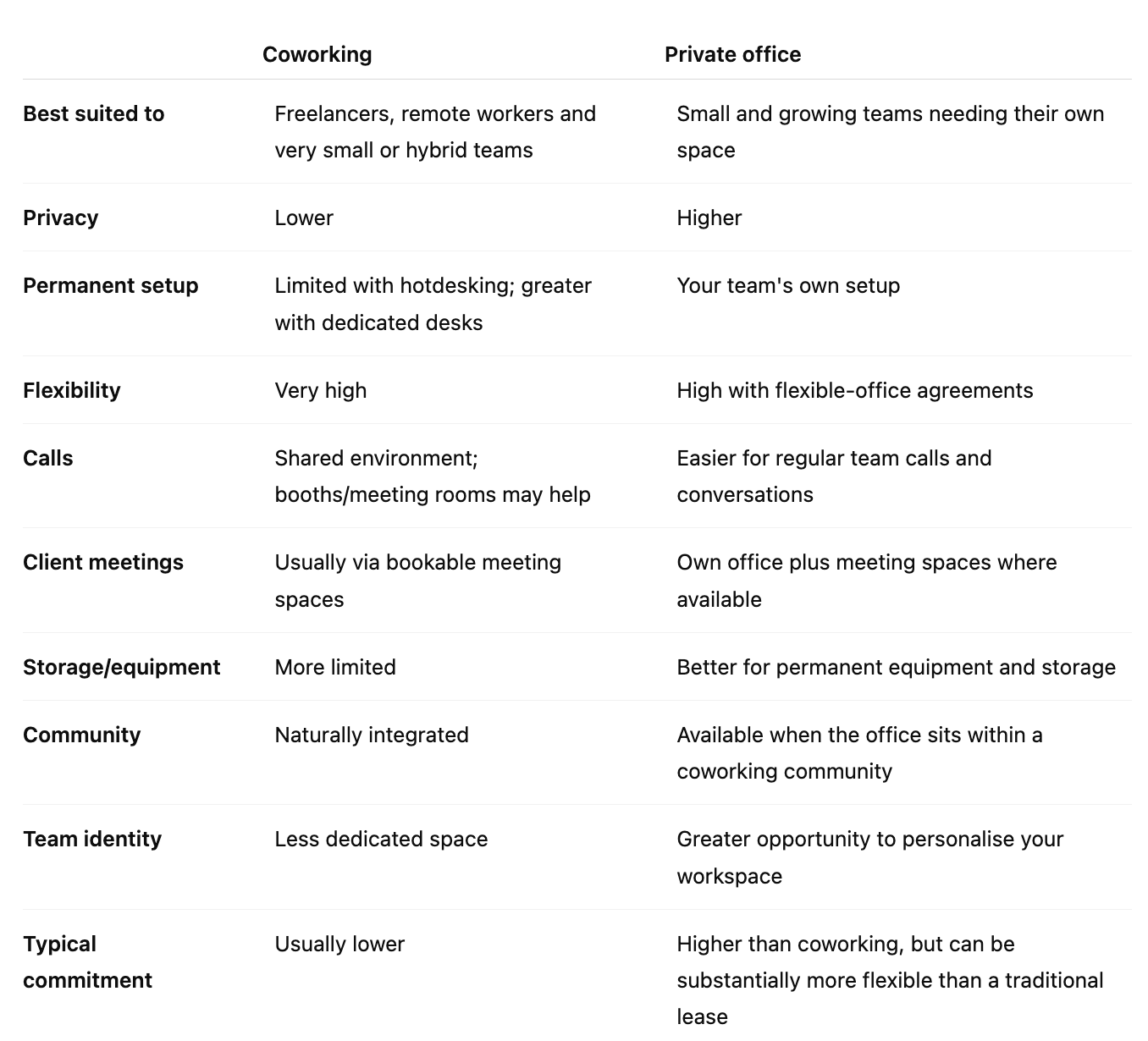
Neither column is inherently better.
The right answer depends on how your business actually works.
When does coworking make more sense?
1. You're a freelancer or solo business
Working from home can be convenient.
It can also mean spending an impressive amount of time discussing your workday with the kettle.
A coworking space gives you somewhere specifically designed for work without the expense of taking an office you don't need.
For freelancers and independent professionals, the separation between home and work can itself be valuable.
Arrive. Work. Leave.
Home gets to become home again.
2. Your team is genuinely hybrid
Hybrid working isn't simply a temporary hangover from 2020.
Office for National Statistics research found that 28% of working adults in Great Britain hybrid-worked during January to March 2025, and subsequent business surveys continue to show organisations incorporating increased homeworking into their permanent models.
For a small hybrid business, that changes the maths.
Imagine you employ six people, but usually only two or three work from the same location on any given day.
Paying permanently for six dedicated workstations may not be the best use of your workspace budget.
Coworking allows the physical space you use to better reflect the way your team actually works.
3. You don't need much privacy
If most of your work happens independently on a laptop, coworking can give you everything you need.
You have a professional place to work without paying for four walls simply because offices traditionally came with them.
The important caveat is calls.
If your day involves confidential conversations, frequent client calls or sensitive information, check what phone booths, meeting rooms or private areas are available.
4. You want flexibility while your business changes
Perhaps you've just hired your first employee.
Perhaps you're testing whether your remote team actually wants to work together regularly.
Or perhaps you're growing but don't yet know what the business will look like twelve months from now.
Coworking can give you room to figure that out before committing to more space.
And if your needs change, the next step could be a dedicated desk — or eventually a private office.
When does a private office make more sense?
1. Your team works together regularly
Once several people are working together frequently, an enclosed space starts offering advantages that aren't purely about privacy.
Your team can talk without worrying about disturbing the room around them.
People can leave monitors and equipment set up.
You can organise the space around the way you work.
And there's something useful about everyone knowing:
This is where we work.
For a growing business, having a consistent base can help create a stronger sense of team.
2. Your work requires privacy
Some businesses simply can't conduct everything in an open workspace.
If your team regularly handles confidential information, sensitive client conversations, HR discussions or frequent calls, a private office can make day-to-day work considerably easier.
You may still use communal spaces when you want them.
But privacy becomes available by closing a door rather than booking another room.
3. You need a permanent setup
Multiple monitors.
Specialist equipment.
Samples.
Documents.
Whiteboards covered in something nobody is allowed to erase.
There comes a point where carrying your working life around in a laptop bag stops being practical.
A private office gives your business somewhere to leave things.
It can also give you more freedom to personalise the workspace around your team and brand.
Most WERKS private offices, for example, come furnished, while teams can personalise their space depending on the particular office and requirements.
4. Clients regularly visit you
Coworking spaces can work brilliantly for client meetings when good meeting rooms are available.
But some businesses benefit from having clients arrive at their office.
That can be particularly relevant for consultancies, agencies and professional services where meetings are a regular part of the working week.
Again, this doesn't mean you need a completely standalone office.
A private office within a wider workspace can provide your team's own base alongside shared meeting and communal facilities.
Is coworking cheaper than a private office in Brighton?
Usually, coworking has the lower entry cost because you're paying for access to shared workspace rather than exclusive use of an entire room.
But once several people need regular desks, the comparison becomes more interesting.
Don't simply compare:
coworking membership × number of employees
against:
private-office monthly rent.
Consider what you're actually getting.
Does the office include furniture?
Broadband?
Utilities?
Business rates?
24/7 access?
Meeting spaces?
Does everyone need a permanent desk?
How many team members are actually present simultaneously?
Could a four-person hybrid team comfortably use coworking instead?
Or are you buying four memberships when a private office would provide more useful space for a similar overall budget?
We've explored these costs in detail in our guide to How much office space costs in Brighton in 2026.
As a real WERKS reference, some current private-office configurations suitable for approximately 3–4 people are around £850 + VAT per month, while other spaces accommodating up to approximately 10 people are around £1,600 + VAT per month.
Those aren't universal rates or quotations. Pricing varies according to the individual office, configuration and availability.
But they demonstrate why businesses should compare the whole workspace cost, rather than automatically assuming that private means prohibitively expensive.
What about a dedicated desk?
There's a useful middle ground that often gets overlooked.
A dedicated desk gives you the community and shared facilities of coworking while providing a workstation that remains yours.
That can make sense when you:
work from the same location regularly
want to leave your setup in place
don't yet need an entire office
want more consistency than hotdesking
enjoy working around other people
For a one or two-person business, it can also provide a natural step between coworking and taking a private office.
What should a team of 2–4 choose?
This is where the decision is often closest.
For a two-person business working together occasionally, coworking may be enough.
If both people need permanent equipment, make frequent calls or work together every day, a small private office becomes more attractive.
For teams approaching three or four people, compare the actual combined membership cost with the private offices available rather than assuming one model will automatically be cheaper.
Also consider where the business is heading.
If you're likely to hire again soon, having the option to move into another office within the same workspace can save you from starting the search again.
What should a team of 5–12 choose?
For teams of this size, private office space often becomes more practical — particularly when several people are regularly present together.
But hybrid working still matters.
A business employing ten people doesn't necessarily need a ten-person office if only five or six typically work there simultaneously.
Before choosing your office size, look at actual attendance patterns.
How many people are in on your busiest day?
How often does everybody come together?
How many people are regularly on calls?
How much meeting space do you need?
Our Guide to choosing private office space in Brighton for teams of 2–12 goes deeper into exactly what you should compare.
Don't forget the environment outside your desk
Workspace decisions are often reduced to price per desk.
People don't actually experience their working lives that way.
They experience the commute.
The coffee before a meeting.
The person they bump into in the kitchen.
Having somewhere else to sit when they've stared at the same screen for three hours.
Being able to ask another business owner a question.
Going to an event after work without travelling somewhere else.
Or simply having other human beings around.
That's one of the reasons coworking developed in the first place, and it's also why a private office inside a coworking community is different from renting an isolated room elsewhere.
The office is private.
The working experience doesn't have to be.
Brighton's office market is changing with the way we work
This isn't just a WERKS observation.
Recent analysis of the Brighton & Hove office market found demand particularly concentrated around smaller, well-specified offices in central locations, with landlords offering high-quality, flexible workspace expected to be well positioned for occupier demand.
That reflects a broader shift.
Businesses haven't stopped needing offices.
Many have simply become more particular about what they need an office to do.
For some, that's providing a permanent headquarters.
For others, it's giving a distributed team somewhere to come together.
And for freelancers, it might simply mean having somewhere to work that isn't the kitchen table.
The useful question is no longer: “Do businesses need offices?”
It's: “What kind of workspace does this business actually need?”
Coworking or private office: how do you decide?
Start with five questions.
How many people will actually use the workspace at the same time?
Not how many people are on payroll.
How much privacy does your work require?
Occasional private calls are very different from confidential conversations throughout the day.
Do you need to leave equipment behind?
If yes, dedicated space becomes more valuable.
How quickly is the team changing?
Avoid paying today for a version of the company that might exist in two years.
What do you want outside your workspace?
Meeting rooms, cafés, community, events, location and transport connections all form part of the decision.
Once you know those answers, the choice usually becomes much clearer.
Find your way of working at WERKS
WERKS has been part of Brighton's working community since 2007.
And there's a reason we don't offer just one way to work.
Some members want somewhere flexible to open their laptop.
Some want the same desk every day.
Some need a door they can close behind their team.
Businesses change, too.
The workspace that makes sense when you're one person may not make sense when you're four.
So rather than starting with “Which product should you buy?”, we'd rather start somewhere simpler:
How do you want to work?
From there, we can show you the options that make sense.
Looking for workspace in Brighton?
Explore coworking, dedicated desks and private offices at WERKS, or come and see the spaces for yourself.
If you're unsure which option suits your business, that's completely fine.
Tell us about your team and how you work, and we'll help you understand the options.
Indicative WERKS private-office prices referenced in this article are correct as of September 2026, exclude VAT and are subject to availability, configuration and current terms.
Coworking vs Private Office FAQs
Is coworking cheaper than renting a private office?
For an individual, coworking will usually have a lower entry cost. For a team, compare the combined cost of memberships with the total cost and facilities included in a private office. The answer changes depending on team size, attendance and what's included.
Is coworking suitable for a small business?
Yes. Coworking can suit small businesses particularly well when teams are hybrid, don't require permanent equipment and value flexibility. Businesses requiring greater privacy or permanent space may find a private office more suitable.
What's the difference between a dedicated desk and a private office?
A dedicated desk reserves a particular workstation for you within a shared working environment. A private office provides an enclosed workspace exclusively for your business or team.
Can a hybrid team use coworking?
Yes. Coworking can be particularly useful for hybrid teams because businesses can access professional workspace without necessarily maintaining a permanent desk for every employee.
When should a startup move from coworking into a private office?
There isn't a fixed team size. Privacy, regular attendance, equipment, client meetings and the combined cost of coworking memberships are better indicators than headcount alone.
Can you have a private office within a coworking space?
Yes. This model gives a business its own enclosed workspace while retaining access to the wider facilities and community of the coworking environment.
