
Working From Home vs Coworking: When Is It Time to Make the Move?
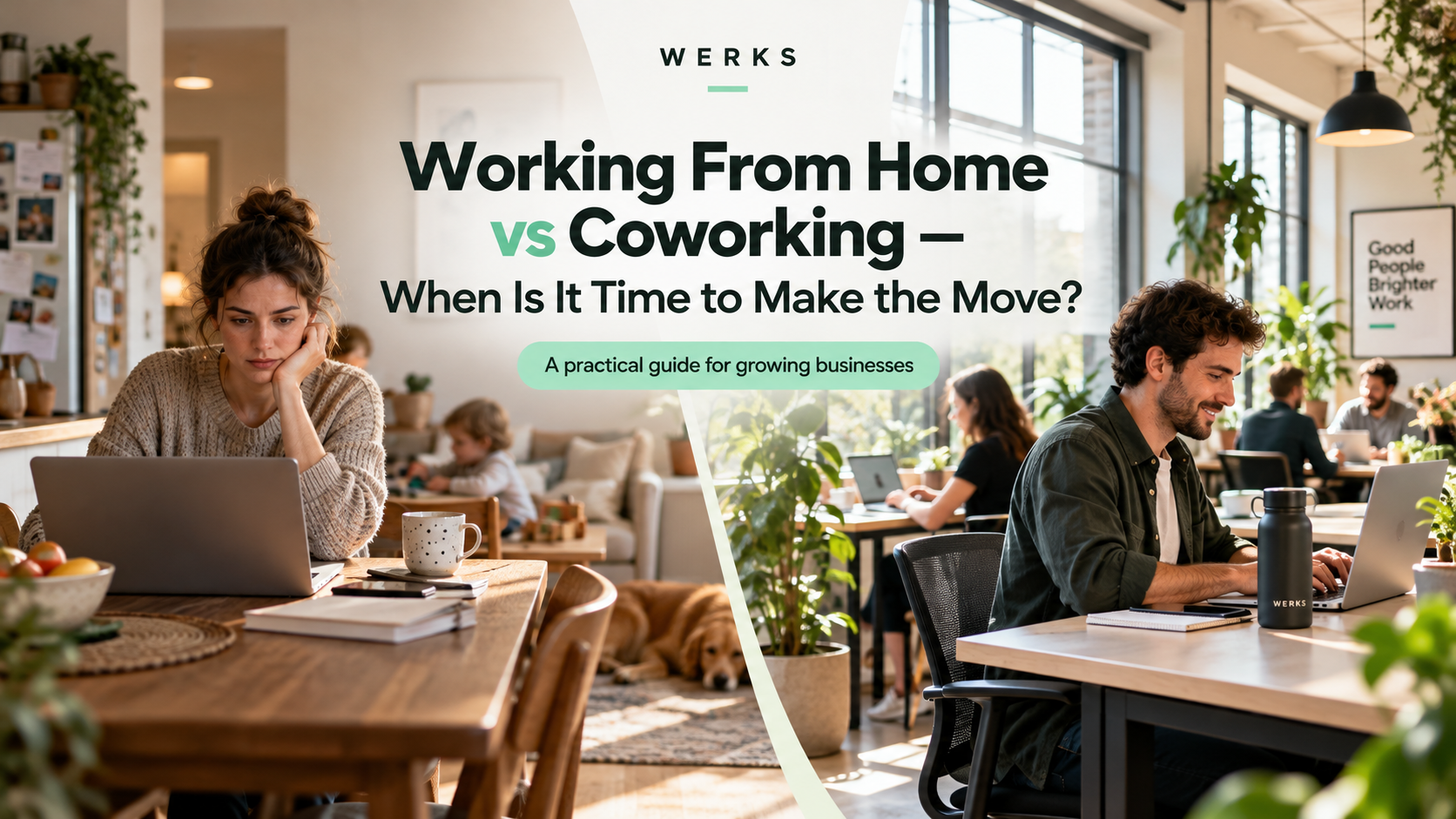
Working from home has its advantages.
No commute. Your own kitchen. Your favourite mug. And nobody questioning why you're wearing slippers during a Monday morning meeting.
For freelancers, remote workers and small business owners, it's often one of the most flexible ways to work.
But sometimes, something changes.
The kitchen table starts feeling a little less productive. Your working day stretches into the evening. You realise you haven't spoken to another person face-to-face all day. Or you simply miss having somewhere to go that feels separate from home.
Does that mean it's time to give up working from home?
Not necessarily.
The choice between working from home and coworking doesn't have to be all or nothing. For many people, the best arrangement is a combination of both.
Here's how to work out what suits you.
Working from home vs coworking: what's the difference?
Working from home means using your own living space as your workplace. Coworking means working in a shared professional environment alongside other people, often with access to desks, internet, communal facilities and a wider working community.
Neither is automatically better.
The right choice depends on the kind of work you do, how you like to spend your day and what your current environment makes easier — or harder.
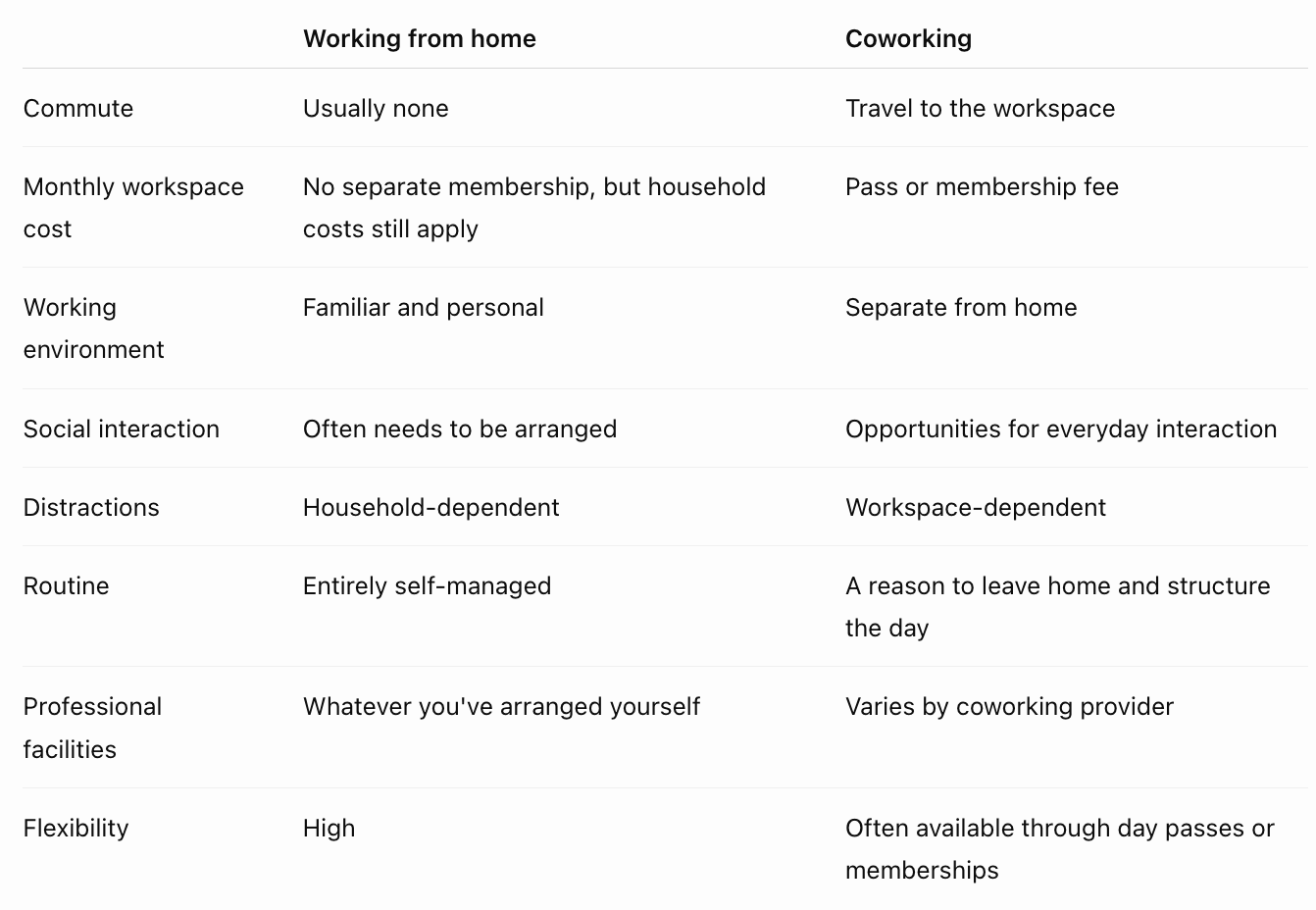
The interesting question isn't which column wins.
It's which parts of your working week could be better.
1. Your home and work life are starting to blur
One of the biggest advantages of working from home is that everything is close by.
Unfortunately, that can also be one of its biggest challenges.
You finish work, but your laptop is still sitting on the dining table.
You answer one more email while making dinner.
You start early because you're already there.
Without a clear separation between home and work, switching off can become surprisingly difficult.
A coworking space gives you somewhere to arrive and somewhere to leave.
That simple change of environment can help create a more intentional routine.
It doesn't mean you need to go every day.
Even one or two coworking days a week might provide the separation you're missing.
2. You're missing everyday human interaction
Working independently doesn't necessarily mean wanting to be alone all day.
You might enjoy the freedom of running your own business but miss the conversations that happen naturally when other people are around.
The quick coffee break.
Asking someone what they're working on.
Hearing about a project completely different from yours.
Having someone nearby who understands the strange experience of being your own boss.
Coworking can create opportunities for those interactions without requiring everyone to work for the same company.
Of course, sharing a workspace doesn't guarantee friendship, collaboration or new clients.
But it does make everyday connection more possible.
And sometimes that's enough to make a working week feel different.
3. You're finding it harder to concentrate at home
Working from home can be wonderfully productive.
Especially when you have a dedicated workspace, a quiet environment and the freedom to structure your day.
But not everyone has those conditions.
Perhaps you're sharing your home with other people.
Perhaps your desk is in the same room as the television.
Or perhaps you've discovered that the laundry becomes extremely interesting whenever a difficult task appears.
A change of environment can help you approach work differently.
Some people find that leaving home creates a clearer sense of purpose: they've travelled somewhere specifically to work.
Others find home quieter and more productive.
The point is to notice where you do your best work rather than assuming one setting should suit every task.
4. Your business needs more than a laptop and a kitchen table
When you're starting out, a laptop and an internet connection might be everything you need.
As your work develops, you might need somewhere to meet clients, take calls, work alongside collaborators or spend longer periods away from household distractions.
A coworking space can offer access to a more established working environment without immediately committing to a private office.
Before choosing a membership, check which facilities are included.
For example:
Reliable internet connectivity
Suitable desks and seating
Quiet areas or phone booths
Meeting-room access
Printing and storage
Opening hours
Accessible facilities
Space for calls or collaborative work
Not every coworking space provides the same facilities, and some services may cost extra.
Choose based on what you actually need.
5. You're spending more time looking for somewhere else to work
There's a particular stage of working from home when you start developing a complicated relationship with cafés.
You know which one has reliable Wi-Fi.
Which one has plug sockets.
Which one gets too busy after lunch.
Which one makes you feel guilty for occupying a table with one coffee.
Cafés can be lovely places to work occasionally.
But if you're spending several days a week searching for somewhere suitable to open your laptop, a coworking membership might be worth considering.
It gives you a workspace designed around people working, rather than hoping a spare table will be available.
And you can still enjoy the coffee.
6. You want more structure without losing flexibility
One of the reasons people choose remote or self-employed work is freedom.
The freedom to organise your day.
Work around other commitments.
Choose where you feel most productive.
So the idea of returning to a workplace five days a week might not sound particularly appealing.
But coworking doesn't have to mean returning to a traditional office routine.
Some people work from home on quieter days and use coworking for meetings, creative projects or days when they want company.
Others book a desk only when they need one.
A flexible arrangement can let you build a working week around the different kinds of work you do.
You don't have to choose between complete independence and a full-time office.
When is working from home still the better option?
Let's give working from home the credit it deserves.
It may remain your best option if:
You have a comfortable, dedicated workspace.
You concentrate better without people around.
You regularly need a very quiet or private environment.
Your work schedule doesn't suit local coworking opening hours.
Travel or membership costs outweigh the benefits.
Working from home supports your accessibility, health or personal needs.
And that's perfectly reasonable.
A good workspace decision should make your life easier, not introduce complications you didn't previously have.
For employees, any change to an agreed working location or pattern may also need to fit their employer's policies and arrangements.
How much does coworking cost compared with working from home?
For many people, cost is one of the first questions that comes up when considering coworking.
Working from home doesn't usually involve paying for a separate workspace membership. And if your current setup works well, there may be no reason to change it.
But what if you could add a professional working environment to your week without taking on the expense of a private office?
At WERKS in Brighton, our coworking memberships include two particularly flexible options:
£49 per month — One day of coworking per week
Ideal if you enjoy working from home but want a regular day somewhere different. It could become your planning day, your creative day or simply a chance to work alongside other people.
£99 per month — Unlimited coworking during opening hours
For those who want more freedom to choose where they work throughout the week, unlimited coworking offers access during the workspace's opening hours for a fixed monthly price.
To put that into perspective, if you use your unlimited membership for 20 days in a month, that works out at approximately £4.95 per working day.
It's not a promise that coworking will make you more productive or save you money. It's simply a way of understanding what a monthly membership could represent in your working routine.
And there's another way to think about it.
For someone running their own business, a workspace isn't necessarily just an additional expense. It can be an investment in having a suitable environment to work, meet people, establish a routine and separate business life from home life.
You don't need to use a coworking space every day to find value in it.
Sometimes one day a week is enough.
Explore WERKS coworking memberships and find the arrangement that works for you.
*Membership prices and access are subject to current terms and availability. Check the latest details before booking.
Could one coworking day a week be enough?
Absolutely.
In fact, that's often a sensible place to start.
Rather than changing your entire routine, try one regular coworking day.
Use it for work that benefits from a different environment.
Perhaps that's your planning day.
Your admin day.
Your creative day.
Or simply the day when you want to be around other people.
After a few weeks, ask yourself:
Did I enjoy it?
Was I comfortable?
Did I get the work done?
Was the journey worthwhile?
Would I want to do it again?
If the answer is yes, you can build from there.
If not, you haven't committed to an entirely new way of working.
What does coworking look like in Brighton?
Brighton has a lively mix of freelancers, independent businesses, creatives and people working remotely.
And one of the lovely things about coworking here is that it doesn't have to feel like a traditional corporate office.
At WERKS, our coworking spaces bring people from different backgrounds and businesses into shared working environments.
Our Middle Street location offers a city-centre workspace with an onsite café and access to the Secret Garden.
At Old Steine, members can work close to the seafront, with a vegan café and yoga studio onsite.
We also offer flexible coworking options, so you can explore what suits your schedule rather than committing to a private office from day one.
You can find the latest passes, memberships, locations and trial-day information on our coworking page.
Five questions to ask before trying coworking
If you're curious but unsure, start here.
1. What am I missing from working at home?
Focus, connection, routine, facilities or simply a change of scene?
2. How many days would I realistically use it?
Be honest about your actual working week.
3. What kind of environment suits me?
Busy and sociable? Calm and quiet? Somewhere in between?
4. What facilities do I need?
Calls, meeting rooms, access hours, storage or particular accessibility arrangements?
5. Can I try it before committing?
A trial day is often more useful than reading ten descriptions of a workspace.
The best workspace might be more than one place
Working from home isn't something you have to grow out of.
For many people, it remains an important part of how they work best.
But it also doesn't have to meet every need.
You can enjoy the quiet of home on Monday.
Spend Tuesday surrounded by other people.
Meet a client later in the week.
And return home when that's where you want to be.
The goal isn't to find one perfect place to work forever.
It's to create a working routine that actually works for you.
Curious about coworking in Brighton?
At WERKS, we believe work should fit the person doing it.
Our Brighton coworking spaces offer flexible ways to work alongside other freelancers, creatives and independent businesses, with options for occasional visits and regular memberships.
If you've been wondering what a change of scene could do for your working week, you don't have to make a big decision.
Start with one day.
Explore WERKS coworking options and check the availability of our first-day trial.
Work Your Way.
Frequently Asked Questions
Is coworking better than working from home?
Not necessarily. Coworking can offer a separate working environment, professional facilities and opportunities for social interaction. Working from home can offer convenience, privacy and flexibility. The better option depends on your work and personal circumstances.
Is coworking worth it for freelancers?
It can be, particularly for freelancers who want a clearer routine, access to facilities or more opportunities to connect with other professionals. An occasional day pass may be a good starting point.
Can I use coworking only one day a week?
Many coworking providers offer day passes or flexible memberships. Check the terms, opening hours and location availability before booking.
Is coworking suitable for remote employees?
It can be, provided the arrangement is compatible with the employer's working policies, information-security requirements and any necessary workplace adjustments.
Can I take video calls in a coworking space?
That depends on the space and its facilities. Ask about phone booths, quiet areas, meeting rooms and call etiquette before choosing a membership.
Where can I try coworking in Brighton?
WERKS offers coworking options at its Brighton locations, including Middle Street and Old Steine.
Visit the WERKS coworking page for current availability, prices and trial-day details.
